Should Med Spa Owners Read the "Medical Aesthetics Success" Book?
To run a medical spa you have to combine two quite different fields of expertise. While you need a solid understanding of the clinical aspect in order to look after your patients properly, you also have to make use of business systems if you are to attract such patients, win their confidence, influence their decisions, and ensure that the practice remains profitable.
Most clinical training doesn't take much time devoted to that second discipline, so med spa owners usually have to rely on trial and error as well as on a collection of advice from vendors, conferences, and social media.
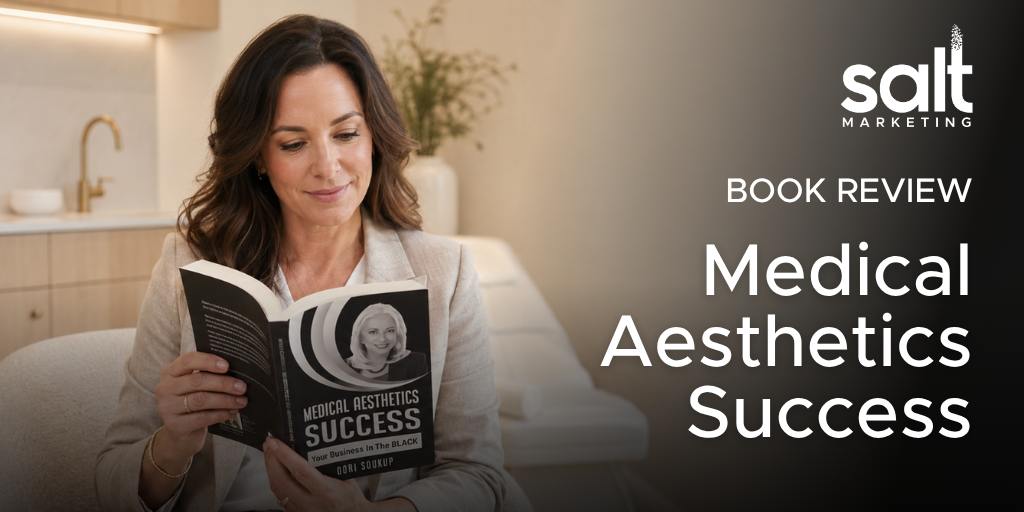
The book Dori Soukup entitled Medical Aesthetics Success: Your Business in the BLACK is intended to give business owners a more thorough basis; this review of the Medical Aesthetics Success book will enable you to find out what it contains, where it provides the most value, and whether it should be included on your list of books to read.
In short, Soukup’s book provides a helpful overview of the business aspects of medical aesthetics, especially for owners who need more robust systems for positioning, conversion, patient experience, and recurring revenue. That said, you'll still need more up-to-date, specialized advice on modern digital marketing, measurement, and technology, which is available on our blog and the Worth Your Salt podcast.
What Is Medical Aesthetics Success About?
Medical Aesthetics Success is 228 pages, divided into four parts and 12 chapters. The author starts by discussing mindset and personal habits before covering positioning, video marketing, referrals, reviews, consultations, patient experience, sales, online revenue, and memberships.
As a result, the book is not merely concerned with the marketing of medical spas; it is a general guide to the medical spa business, based on the principle that profitability relies on the whole patient journey. Although marketing might secure the first inquiry, the practice must still respond to it, convert the customer, provide the service, retain the patient, and expand the relationship.
That wider perspective is one of the book's advantages since rather than viewing marketing as just a series of posts and promotions, Soukup links it to team behaviour, consultations, service delivery, rebooking and lifetime value. The official online edition can be read through MedSpa Biz University.
You will also find proprietary acronyms and references to MedSpa Biz University programmes throughout the Dori Soukup book; these systems give the material a practical organisation, even though the constant references to the programmes make the book seem as though it is an introduction to Soukup's wider training ecosystem.
What Does the Book Teach Particularly Well?
The book is most effective at getting med spa owners to stop viewing each interaction as a separate transaction; instead of securing a patient for a single discounted treatment, Soukup believes the practice should establish a path from initial discovery to long-term loyalty.
Several lessons stand out.
In the first place, the book stresses the importance of establishing expert positioning rather than engaging in price competition; your website, your messaging, your videos, your reviews, your team, and the experience you provide patients all need to make it easier for people to place their trust in your practice, which is why Soukup advises against basing your identity on low prices and frequent promotions.
Second, she views education as a marketing tool. By producing articles, videos, webinars, books, and explanations of treatments, the practice enables potential patients to understand their options while at the same time showing off its expertise. Yet the content must have a purpose. Soukup keeps stressing the need for a relevant offer, a clear call to action, and a defined next step.
Third, the book points out that the tasks of generating leads and converting them are different. Someone has to keep an eye on the inquiries, respond to them promptly, get a good understanding of the prospect's requirements, and invite them to the right kind of consultation; otherwise the practice may end up spending a lot on marketing while the people who are interested simply vanish.
In the end, Soukup presents a compelling argument for considering reviews, referrals, retention, and memberships as part of a marketing strategy. This viewpoint makes the book about the medical spa more useful than a simple advertising guide, since it urges you to measure not only how people discover your business but also what happens after they arrive.
Where Does the Book Feel Less Complete?
Even though the business principles are still valuable, certain specific tactics appear to be out of date or too general. For instance, the book suggests giving out promotional business cards to strangers, applying the “three-foot rule” when starting a conversation, and placing a strong emphasis on short-form provider videos. While these approaches might be effective for some types of people and markets, they won't suit every premium practice.
The book also at times jumps rapidly from talking about education to making an offer, creating a sense of urgency, or providing a gift card. Soukup tends to favour added value over deep discounts, and this is a significant point. Yet it is necessary for practices to avoid substituting dependence on discounts with dependence on offers. Salt looks at this issue in more detail in our article on why med spa discounts do not lead to sustainable growth.
The digital content overview offers more breadth than depth; it includes references to websites, SEO, social media, video, email, analytics, and online consultations. Yet the book fails to go into detail on local search strategy, AI search visibility, paid acquisition, CRM architecture, attribution, or data integration across platforms.
You should also be careful about strategies that use reviews, referral details, and patient images, since the book does mention issues related to releases and HIPAA, but it shouldn’t take the place of advice from a qualified compliance professional. This applies to the use of testimonials and health claims that conflict with the platform's current rules, privacy requirements, and legal advice. It is essential, before introducing any new marketing or methods of communicating with patients, to seek advice from a qualified compliance expert or legal adviser who is knowledgeable about the regulations governing healthcare marketing. Taking this step will help protect your practice from costly errors and ensure you stay fully compliant with existing laws and platform rules. If you are a member of AmSpa (American Med Spa Association), the organization provides a range of resources to help you meet ethical standards.
For the reasons mentioned, Salt Marketing advises treating Dori Soukup's book as an operating framework rather than a full marketing playbook for 2026.
Who Will Get the Most Value From This Book?
The kind of reader who would find this book most useful is one who owns or runs a medical aesthetics practice and understands that clinical excellence alone is not enough to ensure a successful business. You will probably find this book especially helpful if:
- The practice is based on your clinical and technical knowledge but lacks any business fundamentals.
- There is no consistent lead management or consulting process within the sales team.
- Most marketing places a great deal of emphasis on promotions.
- Patients come in for a single service but seldom look into other suitable alternatives.
- Reviews, referrals, and rebookings are carried out in an inconsistent manner.
- You would like to offer memberships or generate recurring revenue.
- Your employees still feel uneasy about giving professional recommendations.
If you're managing a well-established practice, you'll probably see a number of the ideas mentioned in this book. That said, it can still provide you with a common language for leadership and for training your team. However, if your aim is to conduct advanced financial modeling, get detailed instructions on digital campaigns, or handle sophisticated attribution, you'll need access to sources beyond this medical spa business book. If you’re looking for more in-depth information, consider resources such as AmSpa for advice on regulatory and business issues, financial consultants specializing in medical practices, or digital marketing partners with experience in the healthcare sector. It is also possible to gain up-to-date strategies suited to the growth of med spas through continuing education offered by organizations such as the Aesthetic Industry Association, niche financial experts, or advanced marketing conferences.
How Does the Book Reinforce the Salt Marketing Approach?
In the view of Salt Marketing, the most important point in Medical Aesthetics Success is that marketing should not stop once a lead has been obtained; visibility, conversion, patient experience, retention, automation, and measurement all have to function together.
That principle closely supports our Salted Edge Framework: Attract, Convert, Create Raving Fans, Automate, and Measure to Scale. Although Soukup employs different terminology, she presents the framework in a manner that will sound familiar to you if you've been with us for a while. Positioning and educational content are used to attract attention, while lead management and consultations turn that attention into leads. Naturally, providing excellent experiences results in reviews, referrals, and loyalty. Lastly, your data and metrics enable better decision-making and allow you to build on your successes.
The book also supports Salt’s view that premium practices should compete on the grounds of clarity, expertise, trust and experience rather than just by means of more frequent promotions. With both of these methods, the aim is not to increase marketing activity; rather, it is to create a connected system that enables the right people to find you, book with you confidently, and remain valuable patients over time.
The way that Salt develops the system involves putting it into practice and measuring it. Nowadays, all aspects of the practice—its website, search visibility, content, campaigns, CRM, follow-up work, and reporting—must work together to execute a single strategy; otherwise, good ideas will end up as separate tasks that the owner and staff have to remember to carry out.
Is Medical Aesthetics Success Worth Reading?
Yes—with the right expectations. This Medical Aesthetics Success book review finds the book most valuable as an accessible introduction to the systems behind a profitable med spa.
Soukup provides a practical approach to understanding positioning, consultations, the patient experience, reviews, referrals, and recurring revenue; furthermore, the examples she gives that are specific to her industry make the lessons more easily transferable than advice given to businesses as a whole.
Meanwhile, the book does not provide a full guide to modern med spa marketing. Certain tactics will need to be updated and others adapted to your brand, your market, your patient group, and your compliance needs. For instance, if your practice caters to a luxury or specialized clientele, you could modify your referral programme to give people exclusive access to consultations rather than promotional gift cards, or focus on tailored educational material rather than wide-ranging social media campaigns. Such adjustments help make sure that each tactic is in line with the level of service you offer and the reputation you have established. For this reason, use the book to develop and refine your business philosophy and to spot any gaps—not as a set of instructions that you have to follow exactly.
The main lesson is, in fact, very simple—growth arises from the entire relationship, not from the first transaction. Just this one point is enough to make the book worth looking at.
Frequently Asked Questions About Medical Aesthetics Success
Is Medical Aesthetics Success only for new med spa owners?
On the one hand, new owners will receive a clear overview of the business's basic principles; on the other hand, existing businesses will be able to use the book to identify deficiencies in their lead management, consultations, referrals, retention, and membership enrollment.
Does Medical Aesthetics Success focus only on marketing?
No. The book also covers mindset, team performance, patient experience, sales, online revenue, and recurring-revenue programs. Marketing occupies a major portion, although Soukup treats it as one part of a larger business system.
Does the book cover digital marketing for med spas?
Yes, with a broad-brush overview. The book touches on websites, SEO, social media, video, email, webinars, and online consultations. However, it does not provide advanced instruction on current local SEO, AI visibility, paid-media optimization, CRM integration, or revenue attribution.
Is the review of the Medical Aesthetics Success book positive or negative?
Our review of the “Medical Aesthetics Success” book is positive, highlighting its core business philosophy and practical industry focus. At the same time, readers should modernize several tactics and supplement the material with a stronger digital strategy, automation, and measurement.
What should I do after reading the book?
Identify the weakest point in your patient journey before adding another marketing tactic. If you are not sure where growth is breaking down, build your free Med Spa Growth Plan. In about three minutes, you’ll see where your practice is strongest, where revenue may be leaking, and what to address first.