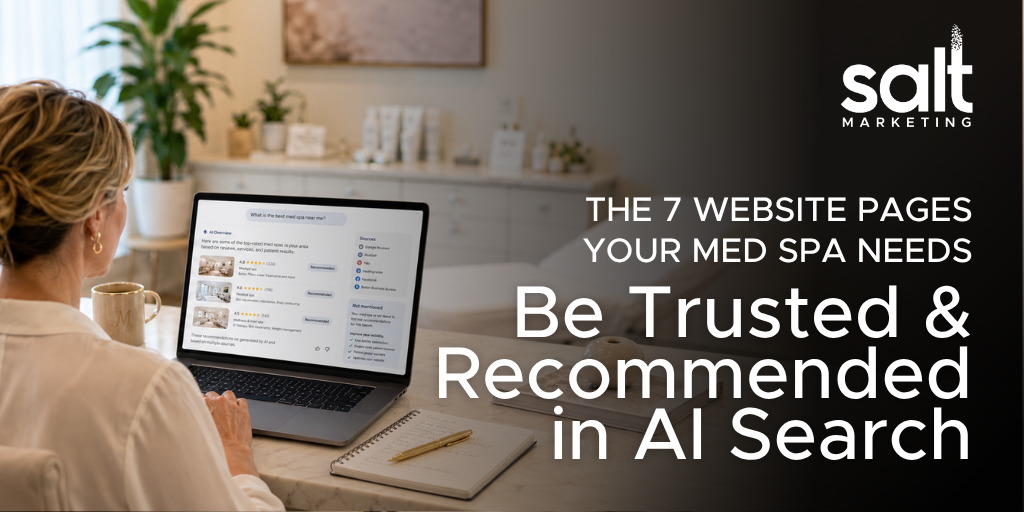
7 Website Pages You Need To Get Found and Recommended in AI Search.
Here is a question worth asking: If a prospective patient asked ChatGPT, Gemini, Claude, Perplexity or Google to recommend the best med spa in your area, would your practice make the list?
More importantly, would the AI platform have enough clear, credible information to explain why someone should choose you?
That was the challenge Marcus Sheridan presented at the Seven Figure Agency Intensive in Miami. Marcus is one of the pioneers of trust-based content marketing and the author of They Ask, You Answer and Endless Customers. His work has long encouraged businesses to stop avoiding the questions buyers really want answered and become the most helpful, transparent voice in their market. His newer work applies that same principle to AI visibility: Does your website give AI systems enough trustworthy information to confidently source, cite and mention your business?
I want to give credit where credit is due: The seven-page framework in this article came directly from Marcus’s presentation. His examples focused largely on home improvement businesses, but as I listened, I could immediately see how powerfully these ideas apply to med spas and wellness practices.
So, I have adapted his recommendations specifically for you: an established med spa or wellness owner helping people make deeply personal decisions about their appearance, health, confidence and well-being.
These are not seven random pages you add to satisfy an algorithm. They are seven opportunities to answer the questions your prospective patients are already asking:
Can I afford this? Is this provider qualified? Is this treatment right for someone like me? Will my information be protected? Do other patients trust this practice? What makes it different from the alternatives?
Those are human trust questions. Increasingly, they are also the questions AI systems are trying to evaluate when deciding which businesses to mention.
No single page can guarantee that ChatGPT or any other AI platform will recommend your practice. Different AI systems use different sources and signals, and those systems are constantly evolving. But Marcus’s broader point is an important one: The more clear, accurate, useful and verifiable information your website provides, the easier it becomes for both people and AI tools to understand and trust your business.
We have already explored this shift in our guide to AI visibility for med spas. Now, let’s get very specific about the pages your website should include.
1. A Transparent Med Spa Pricing Page
Deep breath. I know this is the page that makes many practice owners nervous.
Your pricing may depend on the number of units used, the size of the treatment area, the technology selected, the number of sessions required or the treatment plan recommended after a consultation. You may also worry that publishing prices will make it easier for competitors to undercut you.
But pricing transparency does not mean promising every visitor an exact total before you have evaluated them. It means providing enough information to help someone understand what they may invest, why prices vary and what they will receive for that investment.
“Schedule a consultation for pricing” is not enough anymore.
Imagine you are considering a major purchase and every company refuses to give you even a general price range. You would probably feel frustrated, suspicious or worried that you were about to walk into a high-pressure sales conversation. Your prospective patients may feel exactly the same way.
A strong pricing page can explain that neurotoxin treatments may be priced by unit or area, while laser treatments may be priced per session or package. It can show why one person may require a different number of sessions than another. It can also explain how provider experience, treatment technology, consultation time, follow-up care and the quality of the overall patient experience affect the price.
Marcus’s “perfect pricing page” includes far more than a simple menu. He recommends explaining what drives the price up and down, why some providers are more or less expensive, where your pricing falls within the market, how packaging varies, what financing is available, how the initial investment compares with the lifetime cost and whether the service is genuinely worth the price. He also recommends visual examples, pricing FAQs, videos and, where appropriate, an estimator.
What your med spa pricing page should include
☐ Realistic price ranges for your most important treatments☐ The factors that can increase or decrease the total cost☐ An explanation of per-unit, per-area, per-session and package pricing☐ The likely number of sessions or maintenance appointments☐ The initial cost compared with the longer-term treatment investment☐ Membership, package, payment and financing options☐ Representative treatment scenarios with corresponding price ranges☐ Possible additional costs that are not included in an advertised starting price☐ Answers to the pricing questions your team hears most often☐ A clear explanation of when a consultation is required for an exact quote
You can make this much easier to understand by including examples. You might show a typical price range for a first-time neurotoxin client treating one or two areas, a client purchasing a three-session laser package and a membership client maintaining results throughout the year.
Just be clear that these are examples, not medical recommendations or guaranteed quotes.
You should also answer the uncomfortable pricing questions. Why does one practice charge twice as much as another? What may be missing from an unusually inexpensive offer? When is a package a better value, and when would a patient be better off paying per treatment?
This kind of honesty helps you avoid competing solely on price. In fact, it gives you an opportunity to explain the value behind your pricing before someone reduces your practice to a number on a spreadsheet.
That matters because, as we explain in Why Med Spa Discounts Aren’t Growing Your Business, most new patients are not simply searching for the lowest price. They are looking for reassurance that they can trust you with their face, body or well-being. (Salt Marketing)
Eventually, you might also consider a guided pricing estimator. For a med spa, that does not have to produce a final clinical recommendation. It could ask about the person’s goals, areas of concern and treatments of interest, then provide a general investment range and invite them to schedule a consultation.
The goal is not to replace your provider. It is to give the prospective patient enough clarity to feel comfortable taking the next step.
2. An Honest “Best Med Spas” Comparison Page
Yes, I am recommending that you publish an article about the best med spas in your area.
And yes, that means mentioning your competitors.
Before you close this tab, let me explain.
People are already asking Google and AI tools questions such as:
- What is the best med spa near me?
- Who is the best injector in my city?
- Which med spa is best for natural-looking Botox?
- Where should I go for laser resurfacing?
- Which local med spa has the most experienced providers?
You can ignore those questions and hope someone else answers them fairly. Or you can create the most useful, transparent resource available.
Marcus used the example of a pool company that created a “Top 6 Pool Builders” page. The company first established the criteria that make a pool builder a strong choice, then evaluated each business—including itself—against the same criteria. A comparison chart allowed the reader to see the differences clearly.
The same concept can work for med spas, but it has to be handled with care.
You might create an article titled “The 7 Best Med Spas in Charleston for Natural-Looking Injectables” or “Top Med Spas in Denver for Laser Skin Rejuvenation.” The more specific the search and treatment category, the more useful the article can become.
Before you choose the practices, define what “best” means. For a med spa, your criteria might include provider credentials, years of experience, treatment specialization, consultation process, pricing transparency, review volume, before-and-after documentation, follow-up care and the technologies available.
Then apply those criteria consistently.
What your comparison page should include
☐ A clear description of the type of practice or treatment being compared☐ The criteria used to define “best”☐ An explanation of how the practices were selected☐ A factual profile of each practice☐ Links to the sources used to verify your information☐ Your own practice, evaluated by the same standards☐ A side-by-side comparison chart☐ The date the article was published and last updated☐ A disclosure explaining that your practice created the comparison
You do not need to pretend that every competitor is identical. One practice may be particularly strong in injectables, while another has an impressive range of laser technology. Your practice may offer a more extensive consultation or follow-up process. Someone else may have more locations or longer hours.
Your job is not to make every competitor look bad so that you can crown yourself the winner. Your job is to help the reader make a better decision.
That distinction matters. A thinly disguised sales pitch will not build trust. A thoughtful, balanced comparison can.
Only include claims that you can verify from public sources, and review the page regularly. Teams change, services change and credentials change. A comparison article that was accurate two years ago may be misleading today.
Done well, this page demonstrates a level of confidence most practices will never show. You are saying, “We know we will not be the perfect choice for everyone. Here is how to evaluate your options and decide what is right for you.”
That is a powerful way to stand out.
Page #3: A Complete Med Spa Review Hub
Most med spa websites have a few testimonials on the homepage or a review widget in the footer. That is helpful, but it is not the same as creating a true review hub.
A review hub is one destination where a prospective patient can understand the complete story of your reputation across multiple platforms.
Marcus recommends showing an overview of the review platforms on which the business appears, sharing representative reviews from each source, organizing reviews by geography when appropriate and tracking “review velocity”—how consistently the business is continuing to earn new reviews. His larger point is that AI platforms do not all access or weigh external review sources in exactly the same way. Bringing credible reputation information together on your own website gives visitors and search systems a clearer resource to evaluate.
For your med spa, the page might include Google, Facebook, Yelp, RealSelf, Better Business Bureau listings or relevant industry platforms. Link directly to the original profiles so visitors can verify what they are seeing.
You can also organize your reviews around the concerns that matter to future patients. Someone considering filler may want to read about natural-looking results. A first-time neurotoxin patient may care most about whether the provider listened, explained the treatment and helped them feel comfortable. A laser patient may be looking for feedback about downtime and follow-up care.
When reviews are organized thoughtfully, they become far more useful than a wall of five-star quotes.
What your med spa review hub should include
☐ Your current rating and review total on each relevant platform☐ Direct links to the original review profiles☐ A representative selection of recent reviews☐ Reviews grouped by treatment, provider, location or patient concern☐ Video testimonials when you have appropriate permission☐ Common themes patients mention about their experience☐ Your process for responding to praise and concerns☐ The date the review information was last updated☐ Review growth over time, when you have accurate data to share
Review velocity does not need to become a complicated dashboard. You might simply show how many new reviews your practice has received during the past six or twelve months. A steady flow of recent feedback demonstrates that people are actively visiting and engaging with your practice now.
Be thoughtful about patient privacy. Do not add private treatment details, photographs or identifying information that the reviewer did not make public or authorize you to use. A person leaving a public review does not automatically give you permission to expand on their medical history.
Your review hub should also work together with your local-search strategy. Your Google Business Profile, address, contact information, service descriptions and review activity all help reinforce who you are and where you operate. Our guide to optimizing your med spa’s Google Business Profile can help you strengthen that part of the foundation.
Most importantly, do not wait for reviews to happen by accident. Build a consistent, respectful process for requesting feedback after the patient has had enough time to evaluate their experience. The goal is not to pressure anyone into leaving five stars. It is to make it easy for happy patients to share honest feedback.
Page #4: A Clear Privacy and Security Page
Your prospective patients may be sharing more with you than their email address.
They may submit photographs, appointment requests, treatment interests, financing information or deeply personal questions about their appearance and health. They may also interact with scheduling platforms, payment processors, patient portals, text-message systems and online forms before ever speaking with a member of your team.
A dense privacy policy tucked into your footer may satisfy one requirement, but it does not necessarily help a nervous prospective patient understand how their information will be treated.
Marcus recommends a plain-language security and privacy resource that identifies the tools a company uses, explains what they do and tells the customer why they are used. The goal is to turn privacy from hidden legal language into a visible trust signal.
For a med spa or wellness practice, this page should sit alongside—not replace—your formal privacy policy, terms and any notices required for your business. Think of it as the human explanation.
You might explain that your booking platform collects appointment information so your team can schedule and confirm visits. You might explain that your payment processor handles transactions so payment details are not stored directly on your website. You can identify the systems used for email, text messages, analytics, forms and client communication.
What your privacy and security page should explain
☐ What information your website collects☐ Why each type of information is collected☐ How appointment-request and booking forms are processed☐ How online payments are handled☐ How photographs, testimonials and before-and-after images may be used☐ How email and text-message consent works☐ Which outside platforms process information on your behalf☐ How cookies and analytics tools are used☐ How someone can request access, correction or deletion where applicable☐ Who to contact with a privacy or security concern
Please do not copy another practice’s page, paste in a generic AI-generated policy and assume you are covered. Your actual tools and processes need to match what the page says.
Be equally careful about claims. Do not describe a platform, website or workflow as HIPAA-compliant unless you have verified that it is configured and used appropriately for your practice. The words on the page do not create compliance; your agreements, technology, permissions, policies and day-to-day behavior all have to align.
Because privacy and healthcare requirements vary by business, location and the information being collected, have an appropriate legal or compliance professional review your formal policies and claims.
This page may not feel as exciting as a treatment gallery, but it communicates something incredibly important: You take your patients and their information seriously.
Page #5: Detailed Provider and Author Pages
A small headshot, first name and job title are not enough.
Your prospective patient wants to know who may be evaluating them, touching their skin, administering an injection or guiding a deeply personal wellness decision. They want to understand that person’s qualifications, experience, approach and philosophy before they book.
AI systems also need to connect your educational content and treatment claims to identifiable people with relevant expertise.
Marcus’s author-page framework includes a name and title, headshot, short and full biography, areas of expertise, credentials, certifications, experience timeline, featured articles, videos, topics covered, professional links, contributions to the brand and appropriate schema markup. His presentation also made a wonderfully direct recommendation: Your educational content should have a byline.
For a med spa, you will likely need two connected elements: comprehensive provider pages and clear author or reviewer information on your educational content.
What every provider page should include
☐ Full name and professional title☐ A current, professional photograph☐ Education, licenses and relevant certifications☐ Years and types of experience☐ Treatment specialties and areas of expertise☐ Treatment philosophy and approach to patient care☐ Continuing education and advanced training☐ Professional memberships and links☐ Articles, videos and resources they have created or reviewed☐ A clear way to request an appointment with that provider
Go beyond the résumé.
A thoughtful provider page can answer the questions a prospective patient may be afraid to ask. How does this provider define a natural-looking result? How do they work with someone who is nervous about looking overdone? When will they advise a patient not to have a treatment? What do they want every first-time client to understand?
Those answers help someone connect with the human being behind the credentials.
This is also where personal branding becomes practical. As we explain in our guide to personal branding for health and wellness professionals, a strong professional presence helps communicate your expertise, values and authenticity. It is not about turning every provider into an influencer. It is about helping the right patients understand who they are trusting.
Your educational articles should also clearly identify who wrote them and, when appropriate, who medically reviewed them. Include the person’s credentials, a link to their full profile, the publication date and the most recent review or update date.
Then connect everything. The provider’s profile should link to the articles and videos they have created. Those resources should link back to the provider’s profile. This creates a clear relationship between the person, their expertise and the information published on your site.
Schema markup can help machines understand that relationship, but the visible page comes first. Structured data should describe genuine, accurate content—not try to manufacture authority that the page itself does not demonstrate.
This is one of the reasons Salt Marketing approaches med spa website design as a conversion and trust project, not simply a visual redesign. A beautiful site is valuable, but a site that clearly communicates who you are, why you are qualified and how to take the next step is what helps turn visitors into appointments.
Page #6: An Awards & Recognition Page
Many med spa websites we see display an impressive row of logos with no explanation. The visitor sees a certification badge, local award, manufacturer emblem or media logo—but has no idea what it means, who earned it or whether it is still current. That is a missed trust-building opportunity.
Marcus recommends creating a dedicated awards and recognition page that lists each distinction, links to its original source and explains the criteria. Instead of simply saying “award-winning,” you help the reader verify what was awarded and why it matters.
This page might include local business awards, industry honors, professional recognition, speaking appearances, published contributions, community awards or legitimate distinctions earned by individual providers.
Certifications and advanced training may also be summarized here, although the full details should remain on the appropriate provider page.
What each recognition should include
☐ The name of the award, honor or recognition☐ The organization that issued it☐ The year it was received☐ The practice or individual who received it☐ The criteria or requirements☐ Why it may matter to a prospective patient☐ A link to the issuing organization or original announcement☐ Any important context about how the recognition was awarded
That context is where trust is built.
Was the award selected by an expert panel, based on public voting or tied to a particular performance standard? Did a provider complete an advanced training program, pass an assessment or simply attend a course? Was a badge earned, purchased as part of an advertising package or included with membership in an organization?
You do not need to diminish legitimate recognition simply because there was a promotional or membership component. You do need to represent it accurately.
Avoid creating the impression that a manufacturer, media company or professional organization endorses your practice unless that organization has explicitly said so. And do not keep displaying expired awards or outdated credentials without a date.
A thoughtfully built recognition page is not a trophy wall. It is a verification page.
It tells the visitor, “Here is what we have accomplished, here is who recognized it and here is where you can confirm it for yourself.”
Page #7: A Searchable, Answer-Focused FAQ Hub
Most med spa FAQ pages have six generic questions hidden inside accordion menus:
What should I expect?Does it hurt?How long does it last?Am I a good candidate?
Those questions are not wrong, but they are far too vague to become a truly useful resource.
Marcus describes this seventh recommendation as answer-focused semantic structure. In plain English, that means organizing your content around specific questions, presenting those questions clearly and giving people direct answers that are easy to find and understand.
Your FAQ hub should act as a central library. Rather than putting 100 unrelated questions on one endless page, organize the hub by treatment, concern or stage of the patient journey.
You might have sections for:
- Neurotoxins
- Dermal fillers
- Laser treatments
- Skin rejuvenation
- Body contouring
- Weight management
- Hormone or wellness services
- Consultation and booking
- Pricing and financing
- Safety and side effects
- Before-and-after care
- Memberships and maintenance
Each section can lead to a dedicated category page, such as “View All Botox FAQs” or “View All Laser Resurfacing FAQs.”
Then get specific. Instead of “Does it hurt?” ask, “What does microneedling feel like, and is numbing cream used?” Rather than “How long does it last?” ask, “How long do lip-filler results typically last for a first-time patient?” Don’t present the question as, “What should I expect?” ask, “What should I expect during my first Botox consultation?”
Specific questions are more helpful because they reflect the language real patients use when they search, talk to your team or ask an AI assistant for guidance.
Use this structure for each FAQ
☐ State the exact question as the heading☐ Give the direct answer in the first sentence☐ Explain the most important variables☐ Address relevant candidacy, safety or expectation considerations☐ Link to the complete treatment or service page☐ Identify the author or qualified reviewer☐ Show when the answer was last reviewed☐ Offer a sensible next step without forcing the booking
Some answers may only require two or three paragraphs. Others should become complete articles.
For example, your FAQ hub can briefly answer whether Botox and filler can be performed at the same appointment, then link to a more complete article explaining when combining treatments may or may not make sense.
This gives readers a quick answer while expanding the educational depth of your website.
It also creates the kind of content surface area that helps search systems understand what your practice knows and covers. That is a central theme in The New SEO Game for Med Spas: Modern visibility is not only about matching short keywords. It is about becoming a clear, credible answer to the questions patients are asking as they make a decision.
Remember, however, that an FAQ page still has to support conversion. Give the person a logical path from the answer to the relevant service, provider, pricing information or consultation page. You can find more ideas for creating that path in our guide to increasing med spa bookings.
These seven pages are trust infrastructure—not an AI trick
There is a temptation whenever search changes to chase the newest tactic, plugin or acronym. But the strongest idea in Marcus Sheridan’s presentation was not technical.
It was human.
Say what others will not say. Answer the questions others avoid. Show people how you compare. Explain your pricing. Introduce your experts. Make your reputation verifiable. Be clear about how you protect people. Give useful answers without making someone surrender their email address or sit through a consultation first.
Those actions build the kind of trust that helps a prospective patient choose you.
They also give AI platforms more substantive information with which to understand, cite and potentially recommend your practice.
You do not need to build all seven pages this week. Start with the biggest unanswered questions on your current website.
For many practices, the pricing page is the most important place to begin. Provider pages and a strong FAQ hub are often close behind because they address the expertise, safety and expectation questions that influence whether someone books. Your review hub can then reinforce the experience you promise, while your comparison, privacy and recognition pages add further evidence.
Build each page carefully. Use accurate information. Link to original sources. Add a qualified author. Review the page regularly. One genuinely useful resource is more valuable than seven rushed pages created simply because someone told you AI wants them.
And remember: Getting found is only the first part of the journey. Once someone reaches your site, your message, booking path, follow-up and patient experience still have to work together. That is how you turn visibility into booked appointments and booked appointments into sustainable growth.
Not sure which part of your marketing needs attention first?
You don’t have to guess. Build your med spa’s custom growth plan for free in about three minutes. You will answer a few quick questions and receive a personalized breakdown showing where your practice is winning, where revenue may be quietly slipping through the gaps and the single most important move to make next. It is free, you do not need to schedule a call, and your results are delivered instantly.