Not long ago, getting your med spa found online meant focusing on Google rankings, online reviews, keywords, and maybe a few blog posts sprinkled in for good measure. And for a while, that worked.
But something has changed.
Today, your future patients aren’t just “Googling” anymore. They’re asking questions. They’re typing prompts into AI tools. They’re looking for quick, trustworthy answers to things like “Is Botox worth it?” or “What’s the best med spa near me for natural results?”
And when they do, AI doesn’t show them a list of blue links. It gives them an answer. That answer might include a recommendation. It might summarize a treatment. It might even suggest a specific type of provider. And whether your med spa shows up—or gets skipped entirely—depends on how clearly your marketing helps AI understand who you are, what you offer, and who you’re best for.
The good news? SEO isn’t dead. It’s just evolving. The practices that are getting found—and getting booked—right now aren’t chasing keywords or gimmicks. They’re structuring their websites, content, and online presence around the real questions patients are asking and making it easy for AI to trust and recommend them.
How AI Search Is Changing the Way Patients Find Med Spas
AI search is changing behavior, not just technology. Patients are no longer just searching for “med spa near me” and clicking the first result. They’re researching in conversation. They’re asking follow-up questions. They’re comparing treatments, costs, and outcomes before they ever land on a website. AI tools are designed to help them do that faster.
Instead of ranking pages one by one, AI pulls information from multiple trusted sources and assembles an answer. It looks for clarity. It looks for patterns. And it looks for consensus.
That means your marketing now has two audiences:
- Your patient, who wants reassurance, clarity, and confidence
- AI, which needs structure, context, and signals of trust
- The practices that are winning right now aren’t louder. They’re clearer. They make it easy for both humans and machines to understand what they do and why they’re a good choice.
Why “Ranking on Google” Isn’t Enough Anymore
Traditional SEO taught us to think in keywords. Pick a phrase. Write a post. Hope it ranks. But AI search doesn’t think in keywords—it thinks in questions and intent.
A potential patient might start with:
- “Is Botox safe?”Then move to:
- “How long does Botox last?”And eventually:
- “Best med spa for Botox near me”
AI is connecting those dots. And if your content only answers one small slice of that journey—or spreads the answers across five disconnected blog posts—AI may pull from someone else who made it easier. This is why SEO for med spas now requires a mindset shift.
Instead of creating lots of thin content, the goal is to create one strong, comprehensive resource that clearly answers a patient’s real questions from start to finish.
When AI sees a page that:
- Explains the treatment
- Addresses concerns
- Covers cost considerations
- Clarifies who it’s for (and who it’s not)
- And reflects real expertise
…it recognizes that page as a reliable source. And that’s when visibility turns into bookings.
The Questions Your Future Patients Are Asking AI Right Now
If you want to win at AI search for med spas, you need to stop thinking like a marketer and start thinking like a patient. Your future patient isn’t asking, “Which med spa has the best SEO?” They’re asking questions rooted in uncertainty, curiosity, and readiness.
Things like:
- “Is Botox worth it for first-timers?”
- “What’s the difference between Botox and Dysport?”
- “How much does filler really cost?”
- “How do I know if a med spa is reputable?”
- “What should I ask before booking my first appointment?”
AI loves content that clearly answers those questions in plain language.This is where many med spa websites fall short—not because the information isn’t there, but because it’s scattered, vague, or buried behind marketing fluff.
A powerful shift you can make is to:
- Identify the top 20–30 questions you hear on consultations and intake calls
- Group them by stage (curious, comparing, ready to book)
- Answer them thoroughly and honestly on your website
Not in a salesy way. In a reassuring, educational way. When you do that, you’re not just improving SEO—you’re pre-selling trust.
How to Structure Your Med Spa Content So AI Can Actually Find It
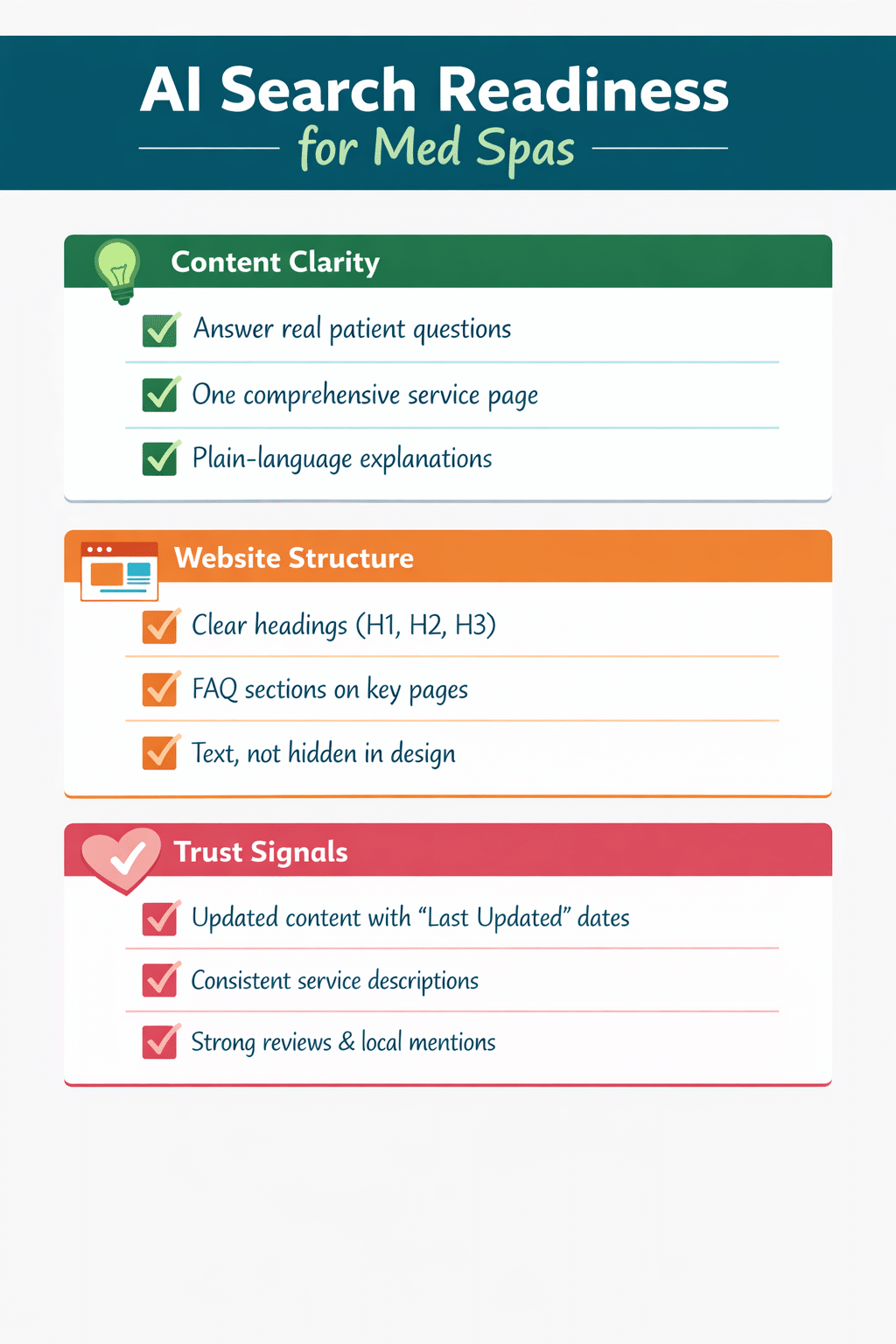
This is where strategy meets execution. AI doesn’t want clever copy. It needs clear structure. That means your most important pages—your core services, your about page, even your homepage—should be built for readability and clarity, not just aesthetics.
Here’s what that looks like in practice: Instead of six short blog posts about Botox, imagine one robust page that:
- Explains what Botox is
- Covers benefits and limitations
- Addresses safety concerns
- Discusses cost ranges
- Compares it to alternatives
- Includes a thoughtful FAQ section
That single page becomes a hub of authority.
Adding FAQ sections is especially powerful. These are gold for AI search because they:
- Mirror natural language questions
- Are easy to scan and extract
- Signal relevance and completeness
The key is to write them the way patients actually ask—not the way marketers phrase things.
And while design matters, make sure your most important content lives in plain, readable text. If critical answers are hidden behind sliders, tabs, or heavy scripts, AI may never see them.
You can absolutely have a beautiful site. Just don’t let beauty hide clarity. Because if you aren’t clear, your visitors are confused - and a confused mind says, “nope.”
Why Fresh, Updated Content Signals Trust to AI (and Patients)
Here’s something many practices overlook: freshness matters again. AI engines prioritize content that feels current and maintained. They want to know that what they’re pulling from still reflects today’s standards, pricing expectations, and patient concerns. That doesn’t mean you need to rewrite everything constantly. It means you should treat your best pages like living assets.
Once a month, ask:
- Are the stats still accurate?
- Are there new patient questions we’ve been hearing?
- Do the examples still reflect how we practice today?
Even small updates—adding a few new FAQs, clarifying language, or visibly showing a “last updated” date—signal credibility. To both AI and the patient reading your site, this says: “We’re paying attention. We’re current. We care.” Because trust compounds.
Brand Mentions, Reviews, and Visibility Beyond Your Website Matter More Than Ever
AI doesn’t just look at your website in isolation. It looks for confirmation. We talk about this in terms of authority signals that tell search you are the answer people are looking for. That means if you med spa shows up consistently across:
- Reviews
- Podcasts
- Articles
- Videos
- Social platforms
- Local mentions
AI sees that as validation. This is where your brand becomes a growth asset. You don’t need to be everywhere. You need to be consistently present in the places your ideal patients already trust.
That might look like:
- Answering common treatment questions on YouTube
- Being quoted in a local wellness article
- Showing up in thoughtful, non-salesy conversations online
- Earning detailed, descriptive reviews that reflect your positioning
When the same themes appear across multiple sources, AI interprets that as consensus—and consensus builds credibility. This is why disconnected marketing efforts don’t work as well anymore. AI favors alignment.
How to Tell If Your Med Spa Is Actually Showing Up in AI Search
Here’s the honest truth: rankings alone won’t tell you if AI search is working for you.
Instead of asking, “What keywords am I ranking for?”, start asking:
- “Am I showing up in AI-generated answers?”
- “How is my practice being described?”
- “Who am I being mentioned alongside?”
- “Is the positioning accurate?”
One of the simplest (and most overlooked) ways to gather insight is to ask new patients:
- “How did you hear about us?”
- “What did you search or ask before booking?”
Their answers will tell you far more than a dashboard ever could. And this is where many med spa owners realize something important: They’re visible—but that doesn’t automatically lead to bookings. Which brings us to the next step.
See How AI Search Is Seeing Your Med Spa Right Now
If reading this has you wondering whether AI search is helping or hurting your visibility, you’re not alone. The gap usually isn’t effort. It’s clarity. That’s exactly why we created the Salt Marketing Online Presence Index.
It’s designed to show you:
- How AI and search engines currently understand your practice
- Where your visibility is strong—and where it’s unclear
- How your website, content, and brand signals are working together (or not)
- What’s getting in the way of being found and booked
Think of it as a snapshot of how your marketing shows up in an AI-first world—so you can stop guessing and start making informed decisions.
You can get your Online Presence Index here.
AI search isn’t something to fear. It’s an opportunity to simplify, clarify, and finally let your expertise work for you—at scale.
And when your marketing makes sense to AI, it makes sense to patients too.