Med Spa Marketing: Why Your Practice Isn’t Getting Found Online (And the 3 Shifts That Fix It)
If you’re like many med spa or wellness business owners, you’ve probably had the same frustrating thought more than once: We’ve done all the right things - why aren’t we more visible online?
You know people are searching for treatments like Botox, laser therapy, or wellness treatments in your area. You’ve invested time in social media, posting regularly, maybe even experimented with paid ads or promotions. You might have hired someone to “handle the marketing” or spent hours trying to keep up with the latest advice about what works online.
And yet, despite all that effort, marketing still feels a bit like a guessing game.
Some months you see a burst of inquiries. Other times it feels quiet and unpredictable. You find yourself wondering if your competitors are doing better than you are, and wondering whether you should be posting more, running more promotions, or trying an entirely different strategy altogether. Instead of creating the steady flow of ideal patients you hoped for, marketing feels inconsistent and difficult to measure—hardly the predictable growth engine most med spa owners are looking for.
What many practices eventually discover is that the problem isn’t a lack of activity. In fact, most med spas are doing quite a lot of marketing. The real issue is that much of it is happening without a clear structure behind it.
When med spa marketing isn’t working, it’s usually not because the practice lacks expertise, great treatments, or satisfied patients. It’s because the messaging is too broad, the content doesn’t consistently build trust, and the website doesn’t guide potential patients toward a clear next step. In other words, the marketing activity is happening—but the strategy that makes it effective is missing.
The encouraging part is that once you understand what’s really happening, the solution becomes much simpler than most of our clients expect. In fact, most practices only need to make three important shifts to transform their marketing from frustrating and unpredictable into something far more reliable.
Let’s start with the first—and perhaps the most common—mistake med spas and wellness practitioners make when trying to attract new patients online.
Shift #1: Stop Marketing Your Med Spa to “Everyone”
One of the most common reasons med spa marketing fails to gain traction is surprisingly simple: you’re not for everyone, and your messaging fails to clearly define who you are for.
Many practices describe themselves in broad, pleasant terms that sound appealing on the surface but ultimately say very little. At Salt Marketing, we often see phrases like “helping you look and feel your best” or “advanced aesthetic treatments for beautiful results.” While these statements aren’t wrong, they’re also not particularly memorable or distinctive.
The problem is that when marketing tries to appeal to everyone, it rarely resonates deeply with anyone.
Potential med spa patients today have countless options when it comes to aesthetic treatments. A quick search online will show them dozens of providers offering similar services in the same geographic area. In that environment, vague messaging blends into the background. Even highly skilled practitioners can become nearly invisible simply because their marketing fails to clearly communicate who they are best suited to help.
This is especially important in the world of aesthetic medicine, where trust plays an enormous role in a patient’s decision-making process. Patients are not simply purchasing a service; they are choosing someone they trust with their appearance, their health, and often a significant financial investment. Before they ever pick up the phone or schedule a consultation, they want to feel confident that a provider understands their specific concerns and has experience helping people like them.
Clear positioning helps create that confidence - and begins to build trust. So rather than speaking to “anyone interested in aesthetics,” successful practices learn to focus their messaging around a specific type of patient and the transformation they want. For example, a med spa might specialize in helping women in their forties maintain natural-looking results, or in supporting busy professionals who want subtle rejuvenation without downtime. Others may focus on acne treatment for young adults or advanced skin correction for patients who have struggled with persistent skin concerns.
When your messaging clearly reflects the needs, concerns, and goals of a specific patient group, potential clients immediately feel a stronger sense of connection. Instead of wondering whether your services might be right for them, they begin to recognize themselves in your content.
If you’re not sure whether your current marketing is clear enough, try a simple exercise.
Take a few minutes to define your ideal client, and what they truly want. Make sure you understand them in the context of their personal journey. Think about what originally brought them to your practice. What concerns or frustrations were they experiencing? What have they already tried before finding you? And most importantly, what transformation are they hoping to achieve?
This small shift, from trying to attract everyone to connecting deeply to your ideal client, often becomes the first step toward med spa marketing that feels more focused, more authentic, and far more effective.
Shift #2: Educate Before You Promote
Once you’ve clarified who you’re speaking to, the next shift is learning how to communicate in a way that builds trust rather than simply trying to drive immediate bookings. This is where many practices unintentionally undermine their own marketing.
A common instinct in aesthetic medicine is to rely heavily on promotions. Limited-time Botox specials, discounted treatment packages, seasonal offers, or social media posts encouraging followers to “book now before spots fill up.” While these tactics may generate occasional bursts of activity, they rarely create the kind of steady, predictable flow of ideal patients that most practice owners are hoping for.
The reason is simple: promotions ask for commitment before trust has been established.
For someone who has never visited your practice before, booking a treatment is a significant decision. Patients want to feel confident about the safety of the procedure, the skill of the provider, and whether the results will align with their goals. If the first message they encounter is a discount or a promotional offer, it often fails to answer the deeper questions they are quietly asking themselves.
This is why the most effective med spa marketing focuses first on education.
When practices consistently share helpful, informative content, they begin to close what we call the trust gap. Instead of simply advertising treatments, they help potential patients understand their options in achieving their goals and support them in feeling more confident about the choices they are making. Over time, this positions your practice not just as a provider of services, but as a trusted authority.
Educational content can take many forms, but the most valuable topics tend to address the questions patients are already researching before they ever contact a provider. They want to understand how different treatments compare, what results they can realistically expect, how much procedures typically cost, and whether they are a good candidate in the first place.
For example, you might publish articles explaining the difference between Botox and Dysport, outlining what to expect during a laser resurfacing treatment, or walking patients through how long results typically last. Consider creating content (videos, blog articles, podcast episodes) addressing common concerns such as recovery time, safety considerations, or how to determine whether a treatment is the right choice for a particular skin concern.
When this type of content becomes a consistent part of your messaging, something powerful begins to happen. Prospective patients start to arrive at consultations already informed, already trusting your expertise, and often already convinced that your practice is the right place for them.
In other words, education quietly does the work that promotions alone cannot.
Instead of constantly chasing attention with new offers, your marketing begins to attract patients who are actively searching for answers—and who naturally gravitate toward the practice that helped them understand their options.
Shift #3: Create a Clear Next Step
Even when you have strong messaging and valuable educational content, there is one more piece that often determines whether your marketing actually turns into booked appointments: giving them the next step.
Many practice websites unintentionally make this part far more complicated than it needs to be. Visitors arrive after reading a helpful article, seeing a social media post, or finding the practice through search, but when they land on the website, they are met with too many options and very little direction. The navigation might include a long list of services, promotions, blog posts, and pages to explore, but nothing clearly tells a potential patient what they should do next.
When that happens, people tend to do exactly what you might expect—they “bounce,” and leave without booking.
This isn’t because they weren’t interested. In many cases, they were genuinely curious about what you offer. But without a clear path forward, even interested visitors often drift away before taking action.
That’s why one of the most important improvements you can make to your med spa marketing is to design a simple, obvious next step for the people who are already paying attention.
Instead of presenting visitors with ten different choices, focus on one primary action you want them to take. Each article or video needs a single call to action, or CTA. That might be scheduling a consultation, completing a treatment assessment, or requesting a personalized recommendation. When that next step is clear and easy to find, visitors are far more likely to move forward.
In some cases, the best next step is not asking someone to book an appointment immediately. Many potential patients are still gathering information, comparing providers, and deciding which treatment might be right for them. Offering a low-pressure way to continue the conversation can be far more effective.
This is where a simple list builder or consultation pathway becomes incredibly powerful. You might invite visitors to download a treatment guide, take a short skin assessment quiz, or receive a personalized recommendation based on their goals. These small steps allow potential patients to raise their hand and say, “I’m interested,” without feeling like they are committing to something too quickly.
From there, thoughtful follow-up can guide them toward the right treatment and the right time to book.
When your messaging is clear, your content builds trust, and your website provides a natural next step, marketing begins to feel very different. Instead of chasing attention or hoping promotions will work, you are creating a pathway that consistently moves interested people toward becoming patients.
And that is when med spa marketing starts to feel far less like a guessing game and much more like a system.
The Real Reason Your Med Spa Marketing Feels So Hard
If marketing has felt frustrating or unpredictable in your practice, it’s easy to assume the problem is effort. Many med spa owners quietly wonder whether they simply aren’t doing enough; posting enough, advertising enough, or trying enough new tactics. But in most cases, the real issue isn’t effort at all. It’s the absence of a system.
Without a clear structure behind your marketing, every new idea feels like another experiment. One week you might try a social media promotion. The next week you might test a paid ad or launch a new special. When something produces a few inquiries, it feels encouraging, but it’s difficult to repeat the results because the underlying strategy hasn’t changed.
Over time, this creates the exhausting feeling that marketing is always starting over. You’re constantly trying new things, but nothing seems to build on the last effort. Instead of creating steady momentum, each campaign feels like a separate attempt to spark interest. When it works, it feels like luck. When it doesn’t, it’s hard to know what to adjust.
This is why so many talented practitioners eventually reach the same conclusion: “Marketing just doesn’t work.” In reality, marketing does work—but it works best when the pieces are connected.
When you have clear messaging that speaks to a specific patient, educational content that builds trust over time, and a simple pathway that guides interested visitors toward the next step, your marketing efforts begin to reinforce one another. Each article, post, or resource becomes part of a larger structure that consistently attracts the right people and moves them toward becoming patients.
Instead of relying on random promotions or occasional bursts of attention, your marketing begins to operate more like a system—one that compounds over time and becomes increasingly predictable.
And once you begin thinking about marketing your wellness business this way, the question is no longer whether marketing works. The question becomes much more useful: Where is your marketing system currently breaking down?
Find Out What Stage Your Med Spa Marketing Is In To Get Found and Get Booked
By this point, you may already recognize parts of your own experience in these shifts. Perhaps your messaging has felt a little too broad. Maybe your marketing has leaned heavily on promotions rather than education. Or you’ve noticed that people visit your website, but far fewer take the next step to book a consultation.
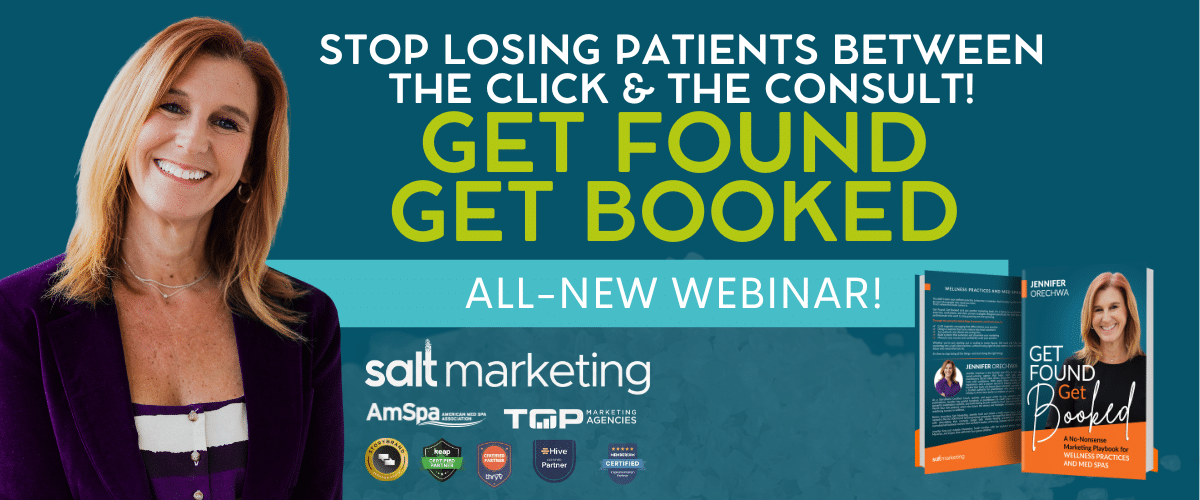
If so, you’re not alone. These are incredibly common challenges for med spa owners, and they don’t mean your practice is doing anything “wrong.” More often, they simply indicate where your marketing system is still developing. In the book Get Found Get Booked, Salt Marketing founder and author Jennifer Orechwa describes five stages that most wellness practices move through as their marketing evolves: Scramble, Stabilize, Systematize, Scale, and Soar.
In the early stages, marketing tends to feel reactive and inconsistent. Practices rely on occasional promotions, word-of-mouth, or bursts of social media activity to bring in new patients. Some months are busy, others are slow, and it’s difficult to predict what will actually move the needle.
As you begin to clarify your messaging, consistently educate your audience, and build simple systems that guide your prospects toward the next step, your marketing starts to stabilize. Eventually, those systems compound into something far more powerful—a repeatable engine that attracts the right patients and keeps your schedule consistently booked.
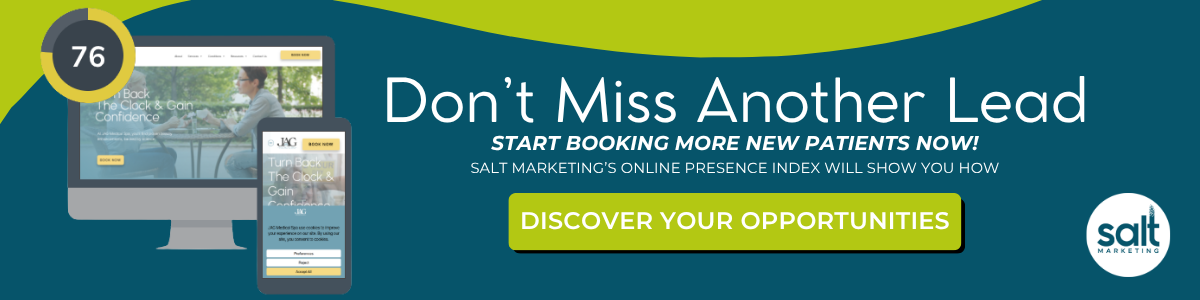
The key question is simple: Where is your practice right now - what’s the logical next step? That’s exactly what Salt Marketing’s Online Presence Index is designed to help you discover.
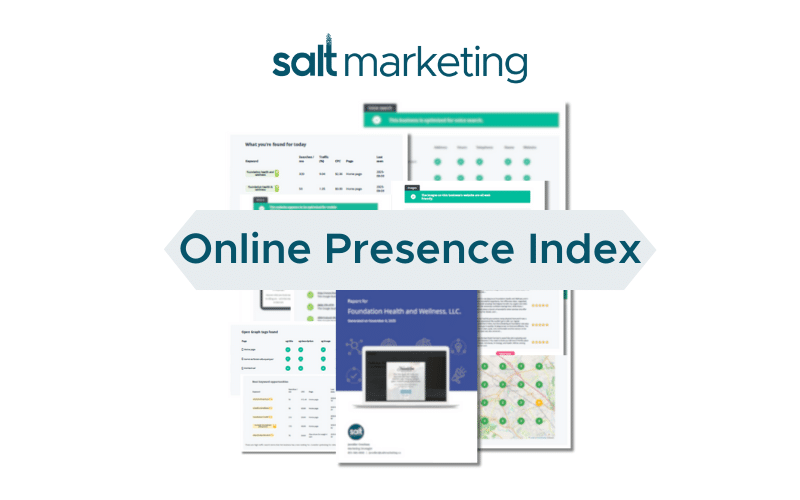
Your Online Presence Index will give you a clear snapshot of how visible and effective your practice currently is online. When you request your OPI, you’ll reveal the factors that influence whether potential patients can find and trust your practice, including your search visibility, keyword presence, local search performance, AI-driven search results, and other signals that influence how your practice appears online.
For many med spa owners and wellness practitioners, seeing this roadmap for the first time is incredibly eye-opening. It often reveals why certain marketing efforts haven’t produced the results they expected—and where the biggest opportunities for growth are hiding.
If you’re curious about how your practice is performing and what your next best step might be, you can request your Online Presence Index from Salt Marketing and get a clearer picture of where your marketing stands today.
Because once you understand where you are in the process, building a marketing system that consistently helps you get found—and get booked—becomes much easier.
When your marketing speaks clearly to the right patient instead of everyone, when your content focuses on educating rather than constantly promoting, and when your website provides a simple and obvious next step, everything begins to function differently. Each article, post, or resource reinforces the others. Potential patients begin to recognize your expertise, trust your guidance, and move naturally toward becoming clients.
Instead of feeling like a guessing game, marketing starts to become something much closer to what most practice owners hoped for in the first place: a predictable pathway that helps the right people find you and feel confident choosing your practice.
And the best part is that once these shifts are in place, marketing often becomes far simpler than it felt before.
So stop chasing attention or trying to keep up with every new tactic. Instead, build a marketing system that quietly works in the background—helping your practice get found by the people who need you most, and guiding them toward becoming loyal patients.