What to Ask a Med Spa Marketing Agency Before You Sign a Contract
Med Spa owners and wellness practitioners don't usually regret hiring marketing help. After all, you need support, it's time to create a marketing system that works. But the regret creeps in when the support you paid for doesn't match what you thought you were buying. The unfortunate truth for trusting (and sometimes desperate-for-help) med spa owners is that generic content, unclear timelines, slow communication, confusing contracts, and poor-quality work usually don't appear out of nowhere. In many cases, the warning signs were there before the agreement was signed, but you just didn't know what to ask.
Choosing a med spa marketing agency is not like choosing a vendor for a simple task or repair. Medical aesthetics is personal, visual, clinical, emotional, and trust-based. Your marketing has to do more than create awareness. It has to carry your brand and your name. It has to build trust by communicating safety, expertise, taste, transformation, and confidence before a patient ever walks through the door.
That is why the right questions matter. Before you sign a marketing contract, you need to understand how the agency thinks, who is doing the work, what is customized, what you own, how success will be measured, and whether the strategy is built to attract the right patients for your practice.
Why Choosing a Med Spa Marketing Agency Is A Whole Different Thing
Med spa marketing carries a different level of responsibility. Your patients are not buying a product. They are trusting a provider with their face, body, health, confidence, and long-term wellness goals. The content on your website, the posts on your social media, the emails in your nurture sequence, and the ads in your market all shape how safe, credible, and desirable your practice feels.
A good med spa marketing agency should understand the difference between generating attention and earning trust. More clicks, calls, or leads may look good on a report, but if those leads are not aligned with your services, pricing, philosophy, or capacity, they can create more pressure without creating better growth.
Before hiring a marketing partner, look for signs that they understand your industry, your positioning, and the full patient journey. At Salt Marketing, we think of this as helping a practice get found, get booked, and grow through connected marketing systems, not scattered tactics that leave you wondering what is actually working.
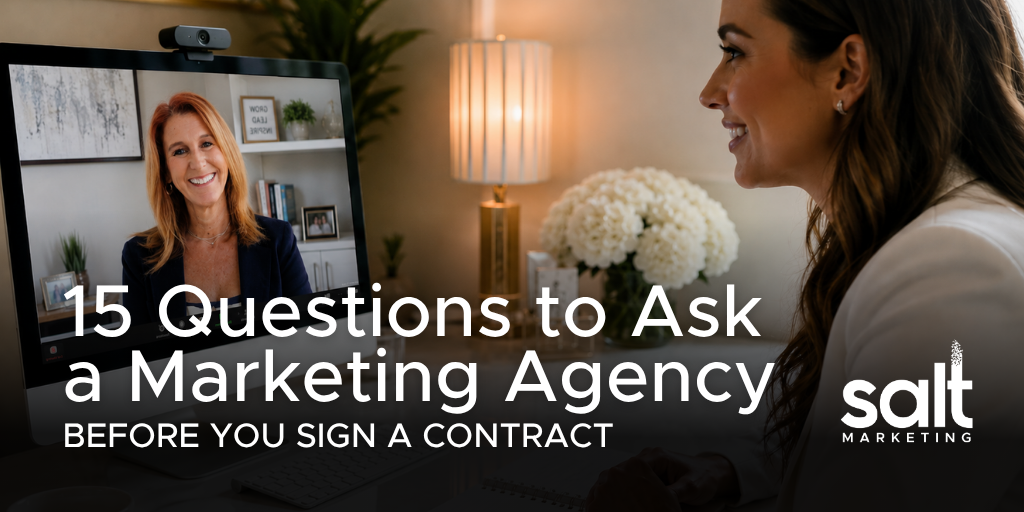
15 Questions to Ask Before Hiring a Med Spa Marketing Agency
The best marketing relationships begin with clarity. A strong agency will not be offended by thoughtful questions; they will welcome them because they know clear expectations protect both sides.
1. Have you worked with med spas, aesthetics practices, or wellness clinics before?
Not every healthcare agency understands aesthetics, and not every local marketing agency understands medical-adjacent services. A med spa needs marketing that can balance trust, beauty, compliance awareness, patient education, and premium positioning. Ask for relevant examples, not just general marketing experience.
2. How do you learn our brand, market, services, and ideal patient?
Generic marketing often begins with a generic onboarding process. Your agency should have a clear way to understand your providers, treatment philosophy, local competition, patient concerns, revenue goals, service mix, and brand voice. If they do not ask thoughtful questions at the beginning, it is unlikely the content will feel specific later.
3. What parts of the strategy are customized versus templated?
Templates are not automatically bad. In fact, a good system can make marketing more consistent and efficient. The question is whether the strategy is customized around your market, services, team, offers, and patient journey. Your Botox content, laser pages, membership emails, and social media strategy should not sound like they could belong to any med spa in any city.
4. Who is actually creating the content?
Ask who writes the blogs, service pages, emails, captions, ads, and website copy. You do not need every person to sit in the same office, but you do need to know who is responsible for strategy, writing, editing, design, approvals, and final quality control. When no one clearly owns the work, small problems can become ongoing frustrations.
5. Do you use AI, and if so, how is it reviewed?
AI can be a useful tool for research, brainstorming, outlines, repurposing, and workflow, but it should not replace strategy, judgment, brand voice, or industry expertise. Ask how AI is used, who edits the output, and how the agency checks for accuracy before anything goes live. In med spa marketing, unedited AI content can make a premium practice sound generic very quickly.
6. What is your quality-control process before something goes live?
Your agency should have a review process for spelling, grammar, formatting, accuracy, brand voice, service details, links, calls to action, and compliance-sensitive language. A typo in another industry may be forgettable, but in medical aesthetics, careless content can make a potential patient question the care behind the brand.
7. What is the website timeline, and what could delay it?
If a new website is part of the agreement, ask for a realistic timeline and a clear explanation of what must happen before launch. Website development includes a whole host of moving parts: content, photography, approvals, integrations, booking links, SEO setup, and revisions can all affect timing. A good agency should be able to explain the process, the milestones, and what happens if either side misses a deadline.
For more context on what a strong wellness website should include, Salt’s website design approach explains why med spa websites need more than pretty design. They need clear messaging, mobile usability, conversion strategy, SEO structure, and a patient journey that helps visitors take the next step.
8. How quickly are revisions usually handled?
Every marketing relationship includes edits. What matters is whether the revision process is clear and reasonable. Ask how requests are submitted, how long basic changes usually take, how urgent issues are handled, and whether you will have a direct point of contact who understands your account.
9. What do we own if we leave?
This is one of the most important questions you can ask. Before signing, clarify who owns the domain, website files, written content, photography, video, ad accounts, analytics, Google Business Profile, email list, landing pages, automations, tracking numbers, and login credentials. You should also understand what happens during a transition if you decide to work with another provider later.
10. How does cancellation work?
Read the cancellation language carefully before you sign. Ask about contract length, renewal terms, notice windows, early termination fees, and what happens if deliverables are late or expectations are not met. Long-term agreements are not automatically bad, but confusing terms create unnecessary stress when a relationship is not working.
11. How will you protect our positioning instead of defaulting to discounts?
Many med spas do not need more bargain hunters. You need the right patients: people who understand the value of the care, trust the providers, and are aligned with your approach. Ask how the agency builds demand without training patients to wait for discounts or reducing your brand to a monthly special.
This is especially important for premium services, advanced treatments, memberships, injectables, lasers, and wellness programs where education and trust matter more than urgency alone.
12. How do you measure success beyond leads?
Leads matter, but they are not the whole story. A strong med spa marketing strategy should also look at qualified inquiries, booked consultations, show rates, website conversion, local visibility, review growth, patient retention, source attribution, service mix, and lifetime value. If the agency only reports activity, you may struggle to understand whether the work is actually moving your business forward.
13. How do all the channels work together?
SEO, social media, email, paid ads, reviews, website conversion, local listings, and automation should not operate like separate islands. They should support one another. Your content should answer the questions patients are searching. Your website should convert that interest. Your follow-up should nurture the relationship. Your reviews should reinforce trust, and your reporting should help you make better decisions.
Salt’s article on the marketing system every med spa needs is a helpful resource if you want to think beyond random posts and campaigns and start looking at marketing as a connected growth engine.
14. What will you need from us to succeed?
Even the best agency needs input from your practice. You may need to provide photos, videos, provider insights, treatment details, approvals, access to platforms, promotional priorities, and feedback on patient quality. Be cautious of any agency that suggests they can create excellent med spa marketing without meaningful participation from your team.
15. What happens if the strategy is not working?
Marketing requires adjustment. Ask how often the agency reviews performance, what metrics they use to make decisions, how they communicate concerns, and what they change when something is not performing. The answer should not be vague reassurance. It should reveal whether the agency has a real process for learning, improving, and optimizing over time.
Red Flags to Watch For
Some warning signs are easy to overlook during the sales process because the promise sounds exciting. Be cautious if an agency is vague about deliverables, avoids questions about who does the work, cannot explain the website timeline, pressures you to sign quickly, or promises leads without explaining lead quality.
Other red flags include unclear ownership of assets, heavy reliance on discounts, reports that show activity without business outcomes, no obvious quality-control process, confusing cancellation terms, or a strategy that does not seem specific to your practice. If the agency cannot explain how your marketing will reflect your brand, services, market, and patient journey, that is worth paying attention to.
A polished sales process does not always mean a thoughtful delivery process. Before you sign, make sure you are just as comfortable with how the work will be done as you are with what is being promised.
Green Flags That Suggest You’re Choosing a Good Partner
A strong med spa marketing partner should ask about your goals, margins, capacity, services, providers, patient experience, local competition, and long-term vision. They should care about the quality of the patients you attract, not just the number of inquiries you receive.
Look for an agency that can explain its process clearly, name what will be customized, describe how content is reviewed, clarify ownership, and connect each marketing channel to a larger strategy. Good partners make you feel more informed, not more confused.
You should also notice whether they understand the emotional side of aesthetics. Patients want to feel safe, seen, and confident. Marketing that ignores that reality may generate clicks, but it will struggle to build trust.
A Better Question Than “Can You Get Me Leads?”
It is natural to ask a marketing agency whether they can get you leads. But for a med spa, a better question is: Can you help the right patients find us, trust us, book with confidence, and come back?
That question changes the entire conversation. It moves the focus away from short-term activity and toward a healthier growth system. It also helps you avoid marketing that fills your calendar with poor-fit consultations, constant discounts, or patients who do not understand the value of your care.
The strongest marketing does not just create visibility. It creates understanding. It helps future patients recognize themselves in your messaging, see your expertise clearly, trust your process, and know exactly what step to take next. That is why we recommend starting with the foundation: your message, your website, your visibility, your follow-up, and your measurement.
If you are unsure where your practice stands today, Salt’s Online Presence Index is designed to show how your practice appears across search, your website, reviews, local visibility, and AI-driven discovery so you can see which gaps are keeping ideal patients from finding and booking with you.
Final Takeaway: Trust Should Start Before the Contract
The right marketing partner will not be offended by careful questions. They will welcome them because the best marketing relationships are built on clarity before the first campaign ever launches.
Before you sign a contract with a med spa marketing agency, take time to understand the strategy, the process, the people, the ownership, the timelines, and the expectations. Your marketing partner will be helping shape how future patients experience your brand before they ever meet you.
That responsibility deserves more than generic content, vague promises, or disconnected tactics. It deserves a thoughtful growth system built around trust.
If you want to see what your current marketing foundation looks like before you hire help or make your next big marketing decision, start with Salt Marketing’s Online Presence Index. We will review how your practice is showing up online and identify the clearest opportunities to help you get found, get trusted, and get booked by more of the right patients.